Description
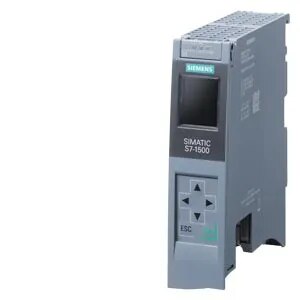
SIMATIC S7-1500, CPU 1513-1 PN, central processing unit with work memory 600 KB for program and 2.5 MB for data, 1st interface: PROFINET IRT with 2-port switch, 6 ns bit performance, SIMATIC Memory Card required
Product type designation CPU 1513-1 PN
HW functional status FS04
Firmware version V4.1
● FW update possible Yes
Product function
● I&M data Yes; I&M0 to I&M3
● Isochronous mode Yes; Distributed and central; with minimum OB 6x cycle of 500 µs (distributed) and 1 ms (central)
● SysLog Yes
Engineering with
● STEP 7 TIA Portal configurable/integrated from version V21 (FW V4.1) / V18 (FW V3.0) or higher; configurable with older TIA Portal versions as 6ES7513-1AL02-0AB0
Configuration control
via dataset Yes
Display
Screen diagonal [cm] 3.45 cm
Control elements
Number of keys 8
Mode buttons 2
Supply voltage
Rated value (DC) 24 V
permissible range, lower limit (DC) 19.2 V
permissible range, upper limit (DC) 28.8 V
Reverse polarity protection Yes
Mains buffering
● Mains/voltage failure stored energy time 5 ms
● Repeat rate, min. 1/s
Input current
Current consumption (rated value) 0.56 A
Current consumption, max. 0.9 A
Inrush current, max. 1.15 A; Rated value
I²t 0.5 A²·s
Power
Infeed power to the backplane bus 10 W
Power consumption from the backplane bus (balanced) 5.5 W
Power loss
Power loss, typ. 3.4 W
Storage
Number of slots for SIMATIC memory card 1
SIMATIC memory card required Yes
Work memory
● integrated (for program) 600 kbyte
● integrated (for data) 2.5 Mbyte
Load memory
● Plug-in (SIMATIC Memory Card), max. 32 Gbyte
Backup
● maintenance-free Yes
CPU processing times
for bit operations, typ. 6 ns
for word operations, typ. 7 ns
for fixed point arithmetic, typ. 9 ns
for floating point arithmetic, typ. 37 ns
CPU-blocks
Number of elements (total) 4 000; Blocks (OB, FB, FC, DB) and UDTs
DB
● Number range 1 ... 60 999; subdivided into: number range that can be used by the user: 1 ... 59 999, and number range of DBs created via SFC 86: 60 000 ... 60 999
● Size, max. 2.5 Mbyte; For DBs with absolute addressing, the max. size is 64 KB
FB
● Number range 0 ... 65 535
● Size, max. 600 kbyte
FC
● Number range 0 ... 65 535
● Size, max. 600 kbyte
OB
● Size, max. 600 kbyte
● Number of free cycle OBs 100
● Number of time alarm OBs 20
● Number of delay alarm OBs 20
● Number of cyclic interrupt OBs 20; With minimum OB 3x cycle of 250 µs
● Number of process alarm OBs 50
● Number of DPV1 alarm OBs 3
● Number of isochronous mode OBs 2
● Number of startup OBs 100
● Number of asynchronous error OBs 4
● Number of synchronous error OBs 2
● Number of diagnostic alarm OBs 1
Nesting depth
● per priority class 24
Counters, timers and their retentivity
S7 counter
● Number 2 048
Retentivity
— can be set Yes
IEC counter
● Number Any (only limited by the main memory)
Retentivity
— can be set Yes
S7 timer
● Number 2 048
Retentivity
— adjustable Yes
IEC timer
● Number Any (only limited by the main memory)
Retentivity
— can be set Yes
Data areas and their retentivity
Retentive data area (incl. timers, counters, flags), max. 216 kbyte; in total; for bit memories, timers, counters, DBs, and technology data (axes)
Extended retentive data area (incl. timers, counters, flags), max. 2.5 Mbyte; When using PS 6 0W 24/48/60 V DC HF
Flag
● Size, max. 16 kbyte
● Number of clock memories 8; 8 clock memory bit, grouped into one clock memory byte
Data blocks
● Retentivity adjustable Yes
● Retentivity preset No
Local data
● per priority class, max. 64 kbyte; max. 16 KB per block
Address area
Number of IO modules 2 048; max. number of modules / submodules
I/O address area
● Inputs 32 kbyte; All inputs are in the process image
● Outputs 32 kbyte; All outputs are in the process image
per integrated IO subsystem
— Inputs (volume) 8 kbyte
— Outputs (volume) 8 kbyte
per CM/CP
— Inputs (volume) 8 kbyte
— Outputs (volume) 8 kbyte
Subprocess images
● Number of subprocess images, max. 32
Hardware configuration
Number of distributed IO systems 32; A distributed I/O system is characterized not only by the integration of distributed I/O via PROFINET or PROFIBUS communication modules, but also by the connection of I/O via AS-i master modules or links (e.g. IE/PB-Link)
Number of DP masters
● via CM 6; A maximum of 6 CMs (PROFINET + PROFIBUS) can be inserted in total
Number of IO Controllers
● integrated 1
● Via CM 6; A maximum of 6 CMs (PROFINET + PROFIBUS) can be inserted in total
Rack
● Modules per rack, max. 32; CPU + 31 modules
● Number of lines, max. 1
PtP CM
● Number of PtP CMs the number of connectable PtP CMs is only limited by the number of available slots
Time of day
Clock
● Type Hardware clock
● Backup time 6 wk; At 40 °C ambient temperature, typically
● Deviation per day, max. 10 s; Typ.: 2 s
Operating hours counter
● Number 64
Clock synchronization
● supported Yes
● to DP, master Yes; via PROFIBUS CM / CP
● on DP, device Yes; via PROFIBUS CM / CP
● in AS, master Yes
● in AS, device Yes
● on Ethernet via NTP Yes
Interfaces
Number of PROFINET interfaces 1
1. Interface
Interface types
● RJ 45 (Ethernet) Yes; X1
● Number of ports 2
● integrated switch Yes
Protocols
● IP protocol Yes; IPv4
● PROFINET IO Controller Yes
● PROFINET IO Device Yes
● SIMATIC communication Yes
● Open IE communication Yes; Optionally also encrypted
● Web server Yes
● Media redundancy Yes
PROFINET IO Controller
Services
— Isochronous mode Yes
— Direct data exchange Yes; Requirement: IRT and isochronous mode (MRPD optional)
— IRT Yes
— Dynamic Frame Packing (DFP) Yes
— PROFIenergy Yes; per user program
— Prioritized startup Yes; Max. 32 PROFINET devices
— Number of connectable IO Devices, max. 128; In total, up to 512 distributed I/O devices can be connected via AS-i, PROFIBUS or PROFINET
— Of which IO devices with IRT, max. 64
— Number of connectable IO Devices for RT, max. 128
— of which in line, max. 128
— Number of IO Devices that can be simultaneously activated/deactivated, max. 8; in total across all interfaces
— Number of IO Devices per tool, max. 8
— Updating times The minimum value of the update time also depends on communication share set for PROFINET IO, on the number of IO devices, and on the quantity of configured user data
Update time for IRT
— for send cycle of 250 µs 250 μs to 4 ms; Note: In the case of IRT with isochronous mode, the minimum update time of 500 µs of the isochronous OB is decisive
— for send cycle of 500 µs 500 µs to 8 ms
— for send cycle of 1 ms 1 ms to 16 ms
— for send cycle of 2 ms 2 ms to 32 ms
— for send cycle of 4 ms 4 ms to 64 ms
— With IRT and parameterization of “odd” send cycles Update time = set “odd” send clock (any multiple of 125 µs: 375 µs, 625 µs ... 3 875 µs)
Update time for RT
— for send cycle of 250 µs 250 µs to 128 ms
— for send cycle of 500 µs 500 µs to 256 ms
— for send cycle of 1 ms 1 ms to 512 ms
— for send cycle of 2 ms 2 ms to 512 ms
— for send cycle of 4 ms 4 ms to 512 ms
PROFINET IO Device
Services
— Isochronous mode No
— IRT Yes
— Dynamic Frame Packing (DFP) No
— PROFIenergy Yes; per user program
— Prioritized startup Yes
— Shared device Yes
— Number of IO Controllers with shared device, max. 4
— activation/deactivation of I-devices Yes; per user program
— Asset management record Yes; per user program
— PROFINET Security Class SNMP Configuration and DCP Read Only
Interface types
RJ 45 (Ethernet)
● 100 Mbps Yes
● Autonegotiation Yes
● Autocrossing Yes
● Industrial Ethernet status LED Yes
Protocols
PROFIsafe No
Number of connections
● Number of connections, max. 128; via integrated interfaces of the CPU and connected CPs / CMs
● Number of connections reserved for ES/HMI/web 10
● Number of connections via integrated interfaces 88
● Number of S7 routing paths 16
Redundancy mode
● PROFINET system redundancy (S2) No
● PROFINET system redundancy (R1) No
● H-Sync forwarding Yes
Media redundancy
— Media redundancy only via 1st interface (X1)
— MRP Yes; MRP Automanager according to IEC 62439-2 Edition 2.0, MRP Manager; MRP Client
— MRP interconnection, supported Yes; as MRP ring node according to IEC 62439-2 Edition 3.0
— MRPD Yes; Requirement: IRT
— Switchover time on line break, typ. 200 ms; For MRP, bumpless for MRPD
— Number of stations in the ring, max. 50
SIMATIC communication
● PG/OP communication Yes; encryption with TLS V1.3 pre-selected
● S7 routing Yes
● Data record routing Yes
● S7 communication, as server Yes
● S7 communication, as client Yes
● User data per job, max. See online help (S7 communication, user data size)
Open IE communication
● TCP/IP Yes
— Data length, max. 64 kbyte
— several passive connections per port, supported Yes
● ISO-on-TCP (RFC1006) Yes
— Data length, max. 64 kbyte
● UDP Yes
— Data length, max. 2 kbyte; 1 472 bytes for UDP broadcast
— UDP multicast Yes; max. 78 multicast circuits
● DHCP Yes
● DNS Yes
● SNMP Yes
● DCP Yes
● LLDP Yes
● Encryption Yes; Optional
Web server
● HTTP Yes; Standard and user pages
● HTTPS Yes; Standard and user pages
● web API
— Number of sessions, max. 50
— number of simultaneous HTTP calls, max. 4
— HTTP request body, max. 131 072 byte
OPC UA
● Runtime license required Yes; “Small” license required
● OPC UA Client Yes; Data Access (registered Read/Write), Method Call
— Application authentication Yes
— Security policies Available security policies: None, Basic128Rsa15, Basic256Rsa15, Basic256Sha256
— User authentication “anonymous” or by user name & password
— Number of connections, max. 4
— Number of nodes of the client interfaces, recommended max. 1 000
— Number of elements for one call of OPC_UA_NodeGetHandleList/OPC_UA_ReadList/OPC_UA_WriteList, max. 300
— Number of elements for one call of OPC_UA_NameSpaceGetIndexList, max. 20
— Number of elements for one call of OPC_UA_MethodGetHandleList, max. 100
— Number of simultaneous calls of the client instructions for session management, per connection, max. 1
— Number of simultaneous calls of the client instructions for data access, per connection, max. 5; for OPC_UA_MethodCall 50 in total (no limit per connection)
— Number of registerable nodes, max. 5 000
— Number of registerable method calls of OPC_UA_MethodCall, max. 100
— Number of inputs/outputs when calling OPC_UA_MethodCall, max. 20
● OPC UA Server Yes; data access (read, write, subscribe), method call, alarms & condition (A&C), custom address space, role-based access control
— Application authentication Yes
— Security policies available security policies: None, Basic128Rsa15, Basic256Rsa15, Basic256Sha256, Aes128Sha256RsaOaep, Aes256Sha256RsaPss
— User authentication “anonymous” or by user name & password
— GDS support (certificate management) Yes
— Number of sessions, max. 32
— Number of accessible variables, max. 50 000
— Number of registerable nodes, max. 10 000
— Number of subscriptions per session, max. 50
— Sampling interval, min. 100 ms
— Publishing interval, min. 200 ms
— Number of server methods, max. 500; max. 25 concurrently running jobs each for asynchronous instructions OPC_UA_ServerMethodPre and OPC_UA_ServerMethodPost
— Number of inputs/outputs per server method, max. 20
— Number of monitored items, recommended max. 4 000; for 1 s sampling interval and 1 s send interval
— Number of server interfaces, max. 10 of each “Server interfaces” / “Companion specification” type and 20 of the type “Reference namespace”
— Number of nodes for user-defined server interfaces, max. 15 000
● Alarms and Conditions Yes
— Number of program alarms 100
— Number of alarms for system diagnostics 50
Further protocols
● MODBUS Yes; MODBUS TCP
S7 message functions
Number of login stations for message functions, max. 32
number of subscriptions, max. 250
number of tags/attributes for subscriptions, max. 2 000
Program alarms Yes
Number of configurable program messages, max. 5 000; Program messages are generated by the “Program_Alarm” block, ProDiag or GRAPH
Number of loadable program messages in RUN, max. 5 000
Number of simultaneously active program alarms
● Number of program alarms 600
● Number of alarms for system diagnostics 100
● Number of alarms for motion technology objects 160
Specifications
| - | -- |
|---|---|
| - | - |